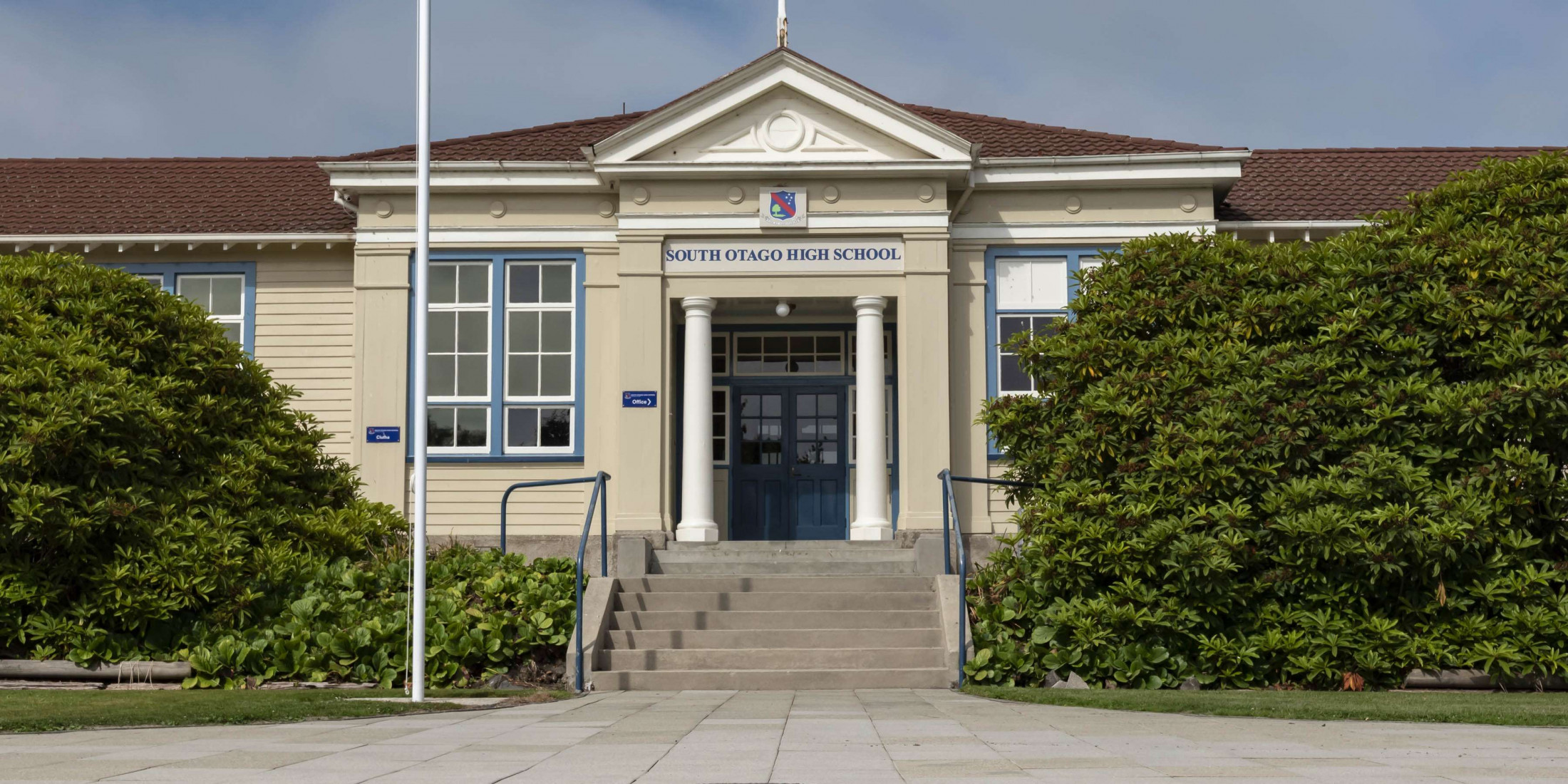
 South Otago High School
This week senior students were spoken to about their final NCEA exams at the end of the term.
They were given their exam admission slips, which outline all the exam papers they are entered into. They need to carefully read this so they know when their exam is and how many papers they are entered into. They must bring this into every exam, it is their admission slip. They must put it somewhere safe now, not make any marks or write on it, and not lose it. If there is an error (a standard missing or a standard they’re not sitting) they should speak to their teacher. If students are entered for exams they no longer plan to sit their caregivers will be contacted to ensure you are aware they don’t intend to sit this paper.
Mrs Cullen, our NCEA Exam Centre Manager, explained the following to students:
Student Pre-exam briefing
- Admission slips have now been distributed. Check your personal details and exam entries are correct. If not talk to your subject teacher or Ms Beaumont.
- All students are to report to the main entrance (library if it is wet) 20 mins before the start of the exam – 9.10am for morning exams or 1.40pm for afternoon.
- If you are ill on the day of your exam please phone the school office as soon as possible after 8am.
- Students will wear school uniform - jackets and hoodies are not permitted in the exam room. These may be left in the foyer along with bags, cell phones, watches and extra paper
- You must have your unmarked admission slip ready to present on entry into the exam room. Once seated check your NSN # against the # on the exam pack.
- Blue or black pens and coloured pencils are to be in a clear plastic bag. Do not use PENCIL or CORRECTION FLUID. If a calculator is required for the exam the memory will be cleared by teachers before entering the exam room. Students sitting digital exams (DE) are to bring a fully charged laptop and can have a power bank stored in the clear plastic bag placed under the desk.
- Entry to the exam is permitted during the first 30 mins of the exam session but after 10am and 2.30pm entry will only be granted with NZQA approval for exceptional circumstances.
- You are not permitted to leave the exam room or visit the toilet in the first 45mins or last 15mins of the 3 hour exam session.
- In the event of an emergency, follow the instructions of the exam supervisors who will direct you to the emergency assembly area – on the terrace in front of the main entrance.
Ms Beaumont spoke to them and said the following:
I want to speak to you about two really important things.
The first is about AI and authenticity. Unfortunately, I had to deal with a surprising number of authenticity breaches during the exam period. I know I have spoken to you before about the importance of using your brain for learning, exercising it, and actually doing the work yourself. Exams and assessments are a test of what you can do independently, not what you can look up or improve with the assistance of someone else or the internet.
I saw something recently that likened using AI to do your work to going to the gym, watching other people exercise but expecting to get the fitness benefits.
You wouldn’t, would you? Go to the gym, watch other people work out and think, “Oh, I’m getting fitter and stronger”... That’s what it’s like every time you use AI. You’re not doing the learning or developing skills.
I get that it seems like the easy way out, and maybe you don’t have time to study or can’t be bothered… but this is where self-management and integrity come in.
You are here at school to get an education. And part of that is learning to manage yourself and your time. Some of you are doing this really well, some are not.
For some of you, I know you are sitting here feeling so frustrated. Frustrated because you don’t cheat, you work hard, and you’re watching your peers “get away with it”. I want to remind you that we notice, we appreciate you, and you can be very proud of yourself if you know you are doing the right thing. That is integrity. It’s respect, and it’s excellence. It is also going to go a long way in the ‘real world’. Tertiary education organisations and employers are not going to respond well to cheating, to saying you can do something when you can’t.
I have had a number of teachers comment that it becomes very apparent in exams where students who have done the mahi during the year can prove it in the exam, and those who can’t. When you leave school, some of you are in for quite the wake up call.
It’s not just about integrity either; it’s about relationships.
As you know, if a teacher suspects your work is not entirely your own, our school policy is that it is on you to prove that it is, not on the teacher to prove that it is not. Every time a teacher has to have a hard conversation with a student about authenticity it puts a strain on the relationship between you and the teacher. This is really unpleasant for everyone.
Teachers don’t enjoy these conversations. When you choose to cheat and force a teacher to question your work and integrity, you damage the relationship and the trust your teacher has for you. It also goes on your record and any future assessments must then be treated with extra scrutiny. Teachers then also consider whether you have cheated in other assessments throughout the year, this casts a shadow of a doubt on all of your achievements, which is most disappointing.
We have excellence and respect as school values for a reason. These are at the core of being successful. That is what we want for each and every one of you. Because you are capable when you put in the work.
This leads me to my second point and about raising our expectations for you. During the derived grade exams we noticed standards slipping. Non-regulation uniform items started appearing, students trying to bring food into exams and the appearance of cellphones, despite the law still requiring them to be “away for the day”.
While uniform and cellphones might seem like minor things, why do we care? I want to share a short story with you.
I want to talk to you about broken windows. This is a criminology theory stating that visible signs of disorder and minor rule breaking create an environment that encourages more serious misbehaviour. It came about in the 1980s by two social scientists who argued that if a broken window in a building is left unrepaired, people passing by will conclude that no one cares and no one is in charge. Soon, more windows will be broken. So over time, this gradually lowers expectations and things get worse.
This was famously applied by the mayor of New York in the 1990s. The New York Police Department shifted focus away from just responding to major felonies and began strictly enforcing "quality-of-life" crimes. They cracked down heavily on things like public drunkenness and graffiti. This led to crime rates dropping dramatically. Now, it wasn’t JUST because of this, but it was an important part of how the culture changed.
What does that have to do with us? We are a PB4L school with high expectations of your behaviour, how you present yourself and the attitude you have towards school. So while uniform and phones might seem minor, these are the things we are going to increase our expectations of. So while some of you were seen with phones during derived grade exams, which weren’t taken off you, they will be at the end of the year. They need to stay away during school hours while you are on site.
You will also be in uniform during your real exams. This is a change this year. The majority of schools around the country expect students to sit their final exams in uniform. South Otago High School does too. This will help reinforce the seriousness of the exams, the formality with which we expect you to arrive and attempt them, and the fact that you are still at school, here to do your best and part of the school community.
Please make sure that as you have your derived grades exams returned to you that you read the feedback, practise with it and stay fully present and engaged with your lessons for the last few weeks before you go on exam leave.